


Traditional Bathroom Vanity Cabinet in Handcrafted Natural Solid Wood
Traditional Bathroom Vanity Cabinet in Handcrafted Natural Solid Wood
Traditional Bathroom Vanity Cabinet in Handcrafted Natural Solid Wood
SKU:WOOD-VAN-TRD-BRN-48x32-0025


In stock
Free Shipping Across the US
We offer free standard shipping on all orders within the United States — no minimum spend, no hidden fees. Orders are typically processed within 7–10 business days, and delivery within the United States usually takes a further 3–7 business days after dispatch.
All duties, taxes and import fees are covered by us. The price you see at checkout is the final price you pay — nothing extra is collected on delivery.
You'll receive tracking details by email as soon as your order leaves our workshop.
1-Year Limited Warranty
WoodEnecho backs every piece with a 1-year limited warranty covering defects in materials and workmanship, valid from the date of delivery. If a covered defect appears, we'll replace the affected parts at no cost to you.
This warranty applies to manufacturing defects only. It does not cover normal wear and tear, improper use, mishandling, or the natural characteristics of solid wood.
Not covered:
- Misuse or handling outside the product's intended purpose
- Damage from harsh cleaning chemicals or unsuitable finishes
- Accidental damage such as scratches, dents, water damage or pet damage
- Damage caused by fire, flood or other natural disasters
- Normal ageing, including fading, colour change and surface wear
After the warranty period: we may still supply replacement materials where available, though labour and shipping costs would be yours to cover.
To make a claim, email us with your order number and clear photos of the issue. We'll review it and get back to you within 10 business days.
30-Day Returns
You may return your item within 30 days of purchase.
Items must be unused, in original condition, with all tags attached.
Note: The return policy applies only to products with defects caused by the manufacturer or damage during shipping.
Our Material Promise — 100% Solid Natural Wood
Every WoodEnecho piece is crafted from 100% solid natural wood — never particleboard, MDF, plywood or surface veneer. Each board is hand-selected and kiln-dried to a controlled moisture level, minimising warping, cracking and insect damage over years of use.
Because wood is a living material, every piece carries its own grain pattern, tone and natural knots — no two are ever identical. These variations are the signature of real wood, not a defect. Actual colour may also differ slightly from product photos due to lighting conditions.
We stand behind what we make. If your item doesn't match its description, we'll arrange an exchange or refund in line with our store policy.
Couldn't load pickup availability
Payment & Security
Product Highlights
- Material: Warm amber Natural Solid Wood, ranging from pale straw through to reddish-brown streaks, with the figure running vertically down the case sides.
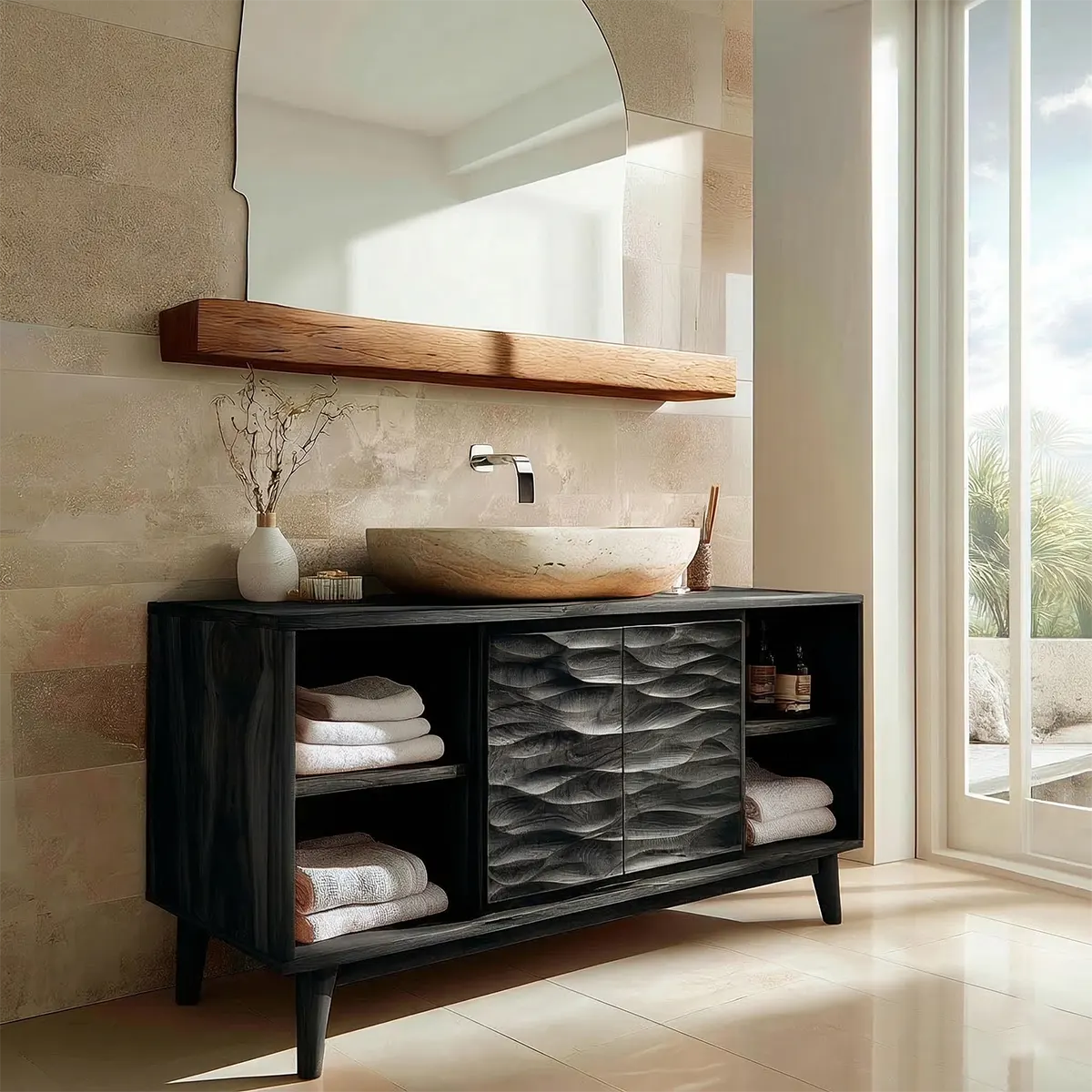
- Carved fronts: The two central doors are hand carved into a dense field of overlapping lens-shaped hollows, laid in staggered courses so the surface swells and dips like a wall of river stones.
- Cabinet doors: Two, meeting on a fine centre seam and closing onto one enclosed bay behind them.
- Open compartments: Four — a doorless bay at either end of the case, each carrying one fixed shelf that splits it into a niche above and a niche below.
- Hardware: None visible. No knobs and no pulls anywhere; the carved edge of each door gives the hand its grip.
- Countertop: A solid slab overhanging the case on the front and both ends, its front line easing very slightly in and out rather than ruled dead straight.
- Case: Thick solid side panels with softened outer corners, and a low rail running along the bottom of the front.
- Base: Four round tapered legs turned to a point at the floor and splayed outward from the case corners.
- Available sizes: 48"W × 18"D × 32"H, 60"W × 18"D × 32"H, and 71"W × 18"D × 32"H.
A Statement of Nature
Morning light is what this cabinet was built for. When the sun comes in low across the room, every hollow in the carved centre panel fills with shadow while the ridge above it catches the light, and a flat pair of doors turns into a relief map that changes hour by hour. By late afternoon the contrast has softened and the same panel reads as quiet texture. Nothing about the piece moves, yet it never looks quite the same twice.
The carving itself is not a pattern of long ripples but a field of individual scooped forms — rounded, lens-shaped, overlapping in staggered rows the way stones lie in a riverbed. Each one has been cut out of the solid, so the depth is real and the shadows inside them are real.
Around that centre everything is calm and open: two clear end bays with towels stacked in plain sight, a slab counter, four slender legs angling out to the floor. The mid-century stance keeps the piece light, the carving keeps it warm, and the combination suits a stone-lined bathroom, a sunlit coastal house or a spa-quiet room built around natural texture.
Natural Materials & Craftsmanship
Case, counter, shelves, both carved doors and the four turned legs are Natural Solid Wood. Relief of this depth settles the question of construction by itself: the maker is removing a great deal of material from the face of each panel, and only genuinely solid stock can lose that much thickness and still hold together.
Every hollow is cut individually with a gouge and then worked smooth inside, which is why no two are exactly matched in size, depth or angle, and why the courses drift very slightly out of alignment as they cross the door. That drift is the signature of a hand rather than a press. Look at how the grain climbs over each swell and dives into each scoop — figure that behaves that way is being carved through, not printed on.
The rest of the cabinet is built for restraint. Substantial side panels are used, and every outer corner on them is rounded off by hand so the box never feels sharp to walk past. Each end bay is framed on three sides with its shelf let cleanly into the sides. The counter is planed flat and its front line is left with a gentle wander instead of being ruled straight. Each of the four legs is turned on a lathe, drawn down to a fine point where it meets the tile, and let into the underside on a slight outward angle — enough to brace a long case with no stretcher showing anywhere.
Every surface is sanded by hand and sealed under a low-lustre coating chosen for damp rooms, protective enough for daily use yet never shiny enough to flatten the relief. The colour range holds four entries — Brown Tone Finish, Walnut Tone Finish, Oak Tone Finish and Black Tone Finish — and each entry is a coat of colour, not a different tree. Species is not an option we sell.
Sculptural Design
Read the front as three panels across. In the middle sit the two carved doors, together forming one continuous field of relief broken only by the hairline where they meet. They swing outward from that seam onto a single enclosed bay with nothing dividing it, so the tall interior takes bottles standing upright, spare rolls and cleaning supplies without a shelf getting in the way. Nothing is fixed to their faces — no knob, no pull, no plate — because any fitting would have punched a hole straight through the carving. The sculpted lip along each opening edge is what your fingers find instead.
At either end the case opens up completely. A single fixed shelf crosses each bay at mid height, so each end yields two niches and the piece carries four open compartments in all. The upper pair sits at easy reaching height for folded towels or a row of bottles; the lower pair takes taller stacks, a basket or a boxed spare. Being open on the front, both bays are also part of how the piece looks — what you keep in them is on show, and they were sized on the assumption you would use that.
Across the top runs a solid slab that projects past the case at the front and at both ends. Its face is flat and unbroken; there is no recess shaped into it to seat a bowl and no aperture bored through it for a spout, so a vessel bowl can be set wherever the plumbing wants it and a deck tap or a wall tap can be positioned to match. The front line of the slab eases in and out very gently along its length — not a natural edge, just a hand-finished line that never quite goes rigid.
Underneath, a low rail runs along the bottom of the front, tying the two end bays and the door bay together and closing the composition off cleanly. The four round legs continue below it, splaying outward as they descend and tapering to a small foot, so the whole case appears to stand up off the tile rather than sit down on it. Floor stays visible under the entire piece, which matters more than it sounds in a room this size.
Versatile Placement
Open end bays and one deep closed bay divide the storage sensibly, which makes this a practical choice as well as a decorative one.
- Main bathroom in one of the two larger widths, with daily towels in the open niches and everything unattractive shut behind the carved doors.
- Any room with a window set to one side or a glazed door close by, since raking daylight is what makes the carved field perform.
- Guest bathroom, where towels stacked in the open niches read as hospitality without any explanation.
- Powder room in the 48" width, using the carved centre as the room's one deliberate gesture.
- Spa, wellness room or changing area, where open shelving beats doors for pieces in constant circulation.
- Stone, travertine or plaster interior, where the amber timber supplies the only warmth in an otherwise mineral palette.
Customization
Three standard sizes are made, sharing one depth and one height so the counter sits at a consistent level: 48"W × 18"D × 32"H, 60"W × 18"D × 32"H, and 71"W × 18"D × 32"H. All three keep the same three-part front — carved doors at the centre, an open shelved bay at each end. Custom sizing may be available on request. Let us know the length of wall you are working with and roughly where the pipes emerge, and we will say whether it can be made.
Four tone finish options are available: Brown Tone Finish, Walnut Tone Finish, Oak Tone Finish and Black Tone Finish. Every one of them is a colour laid on the surface; none of them is a different kind of timber. On a carved front the tone does something visible: lighter tones let each scoop read as a soft gradient and keep the field gentle, while the darkest tone drops every hollow into deep shadow and turns the same doors into a sharply graphic relief. It is worth deciding which of those two effects you actually want before ordering.
Natural grain and tonal variation make every piece one of a kind, and because every hollow is cut by hand the rhythm of the carved field on your cabinet will not be a copy of the one photographed. Minor dimensional variation may occur due to the handcrafted process, and production photos or videos may be provided upon request.
Care & Maintenance
The carved doors need a brush, not a cloth. A cloth rides across the ridges and leaves the hollows untouched, whereas a soft dry brush or a clean paintbrush reaches into every scoop in seconds. Work across the courses, then along them, and the whole panel comes up clean without anything being pressed into the recesses.
Leave the slab dry at the end of each use, above all in the strip behind the bowl and directly under the spout, where water gathers without anyone noticing. Catch splashes as they land, using a cloth wrung out almost dry, then take a second pass to leave the slab dry; do not leave standing water, wet bottles or a damp shaving kit sitting on the slab.
Because the end bays are open, whatever goes into them sits directly against the wood. Let towels dry properly before they are folded and stored, wipe the shelves and the bay floors occasionally, and avoid keeping a damp basket permanently in the lower niches.
Swing the carved doors open now and then so the shut bay behind them can breathe, which matters most in a bathroom where the extraction is weak. Bleach, ammonia, solvent cleaners and scouring pads should never reach this finish at all — drag an abrasive pad across a carved panel and it polishes the ridges while leaving the hollows dull, and there is no undoing that. Refresh the timber now and again with a wood oil or wax in a shade suited to the colour you chose, brushing a little down into the relief so ridge and hollow keep the same depth of colour. Air the room properly once bathing is done, set the cabinet on ground that is level so no single leg carries more than its share, and look over the leg fixings and the hinges once or twice a year.
Important
- Two hand carved cabinet doors at the centre, opening onto one undivided enclosed bay.
- Four open compartments — one shelved bay at each end of the case, divided into an upper and a lower niche.
- No drawers on this model.
- Nothing metal appears on the piece — no knob, no pull, no plate; the sculpted door edge is the grip.
- A solid slab counter overhanging the case, delivered with neither a bowl aperture nor a spout hole cut into it.
- Freestanding on four round tapered legs splayed outward at the corners; the floor remains visible right under the case.
- Handcrafted from Natural Solid Wood.
- Decorative items are not included.
Once our products are finished, we disassemble them into several pieces before shipping. This isn't a shortcut — it's actually to protect your order! Our pieces can be large and bulky, so breaking them down makes them much easier to package securely and move safely, which means your item arrives without any dents, cracks, or damage from bumps during transit.
No worries about assembly, though — our craftsmen carefully design every joint and connection to fit together snugly and precisely once you put it together. Plus, we include detailed assembly instructions with every order, so you can set everything up with confidence.
Note
- Listing includes the carved wooden vanity cabinet only, in the size and finish selected.
- No sink or basin is supplied. The pale stone vessel bowl resting on the counter in the photographs is a styling prop.
- No faucet is supplied. The chrome wall spout in the photographs is there for staging, and every part behind it — waste outlet, trap, isolating valve, feed pipe, fixing kit — falls outside this order as well.
- No mirror is supplied, and the heavy timber wall beam and shelf mounted above are separate purchases that do not travel with this cabinet.
- The remaining props are excluded too: the white ceramic vase of dried branches, the small striped box, the amber bottles, the reed diffuser, the folded grey and white towels, and the stone cladding on the wall behind.
- Each piece is handcrafted from Natural Solid Wood with unique grain and tonal variation.
- Slabs are dispatched solid — nothing is bored and nothing is cut away for a bowl or a spout — unless we agreed otherwise in writing ahead of the build.
- Variation in the depth, spacing and alignment of the carved hollows is inherent to hand cutting and is not a fault.
- Those four names cover colour only. Order any width in any of them and the material beneath stays exactly the same.
Shipping
Free Shipping Within the US
We proudly offer free shipping on all orders delivered within the United States.
Estimated Delivery Time
Each piece is carefully handcrafted to order. Total delivery time is approximately 10-17 business days, including production and shipping.
Returns
30-Day Return Policy
If you are not completely satisfied with your purchase or simply change your mind, you may request a return within 30 days of receiving your order. We cover the full cost of return shipping for all returns — no return shipping fee or restocking fee under any circumstance.
For full details, see our Shipping Policy and Refund Policy.
Wood Care Instructions
Avoid Water & Excess Humidity
Wipe away any standing water immediately and avoid prolonged exposure to moisture. To preserve the beauty and durability of the Natural Solid Wood, do not place the product in excessively humid areas or near direct heat sources.
Protect From Direct Sunlight
Extended exposure to strong sunlight may cause the wood to fade, dry, or naturally shift in color over time. For best longevity, place the product in a cool, dry environment with soft or indirect light.
Gentle Cleaning
Dust regularly using a soft, dry cloth. Avoid harsh cleaners, chemicals, or abrasive materials that may damage or scratch the wood surface.
Periodic Wood Maintenance
Every 6–12 months, apply a wood conditioner or natural wax to help nourish the wood, maintain its luster, and improve moisture resistance.
Protect the Surface
Use coasters, pads, or protective mats under glasses, vases, and heavy or sharp objects to help prevent scratches, dents, or surface marks.
Inspect & Tighten Hardware
For products featuring screws, joints, or traditional mortise-and-tenon construction, periodically check and tighten connections to ensure long-term stability and strength.


Handcrafted from Natural Solid Wood
Handcrafted from Natural Solid Wood
Handcrafted from Natural Solid Wood
Handcrafted from Natural Solid Wood
Handcrafted from Natural Solid Wood
Handcrafted from Natural Solid Wood
Handcrafted from Natural Solid Wood
Handcrafted from Natural Solid Wood
Handcrafted from Natural Solid Wood
Handcrafted from Natural Solid Wood
Handcrafted from Natural Solid Wood
Handcrafted from Natural Solid Wood
Handcrafted from Natural Solid Wood
Handcrafted from Natural Solid Wood
Handcrafted from Natural Solid Wood
Handcrafted from Natural Solid Wood
Free Shipping Across USA
Free Shipping Across USA
Free Shipping Across USA
Free Shipping Across USA
Free Shipping Across USA
Free Shipping Across USA
Free Shipping Across USA
Free Shipping Across USA
Free Shipping Across USA
Free Shipping Across USA
Free Shipping Across USA
Free Shipping Across USA
Free Shipping Across USA
Free Shipping Across USA
Free Shipping Across USA
Free Shipping Across USA
Why Choose Us

Natural Solid Wood
Rich grain and one of a kind character.
Made to Order
Prepared with care for each design.
Free Shipping
Delivered across the USA with care.
30 Day Return
Added confidence after purchase.
Secure Checkout
Protected payment experience.
Custom Sizes
Selected designs can fit your space.

Natural Solid Wood
Rich grain and one of a kind character.
Made to Order
Prepared with care for each design.
Free Shipping
Delivered across the USA with care.
30 Day Return
Added confidence after purchase.
Secure Checkout
Protected payment experience.
Custom Sizes
Selected designs can fit your space.
Frequently Asked Questions
Are the colors exactly the same as shown in the photos?
Are the colors exactly the same as shown in the photos?
We strive to present every finish as accurately as possible. However, because each piece is handcrafted from Natural Solid Wood, natural grain variations, lighting conditions, and screen settings may cause slight differences in appearance. These subtle variations are part of what makes every piece unique.
Does the furniture require assembly?
Does the furniture require assembly?
Some products may require light assembly upon arrival. All necessary hardware and installation instructions are included to ensure an easy setup experience. If you need any assistance, our support team is always available to help.
Is the wood protected against termites and moisture?
Is the wood protected against termites and moisture?
Yes. Each piece is carefully prepared and finished for long-lasting durability.
- The wood is properly dried and treated before production
- A protective finish is applied to help resist moisture and daily wear
- Secure packaging helps protect the furniture during transit
With proper indoor use and care, your furniture is designed to remain beautiful for years to come.
Do you offer customization?
Do you offer customization?
Yes, we gladly offer customization options for selected products. You may request adjustments to dimensions, finishes, or certain design details to better suit your space and preferences. Please contact us to discuss your custom request.
How should I care for my furniture?
How should I care for my furniture?
To keep your furniture looking its best:
- Wipe regularly with a soft dry cloth
- Avoid harsh chemicals and abrasive cleaners
- Keep away from prolonged moisture and direct heat exposure
- Use wood-safe cleaning products when necessary
Proper care will help preserve the natural beauty of the wood over time.
Do you ship internationally?
Do you ship internationally?
No, we currently do not offer international shipping. At this time, we only ship within the United States, and free shipping is included on all orders.


