


Rustic Live Edge Slab Coffee Table with Solid Block Base in Natural Solid Wood
Rustic Live Edge Slab Coffee Table with Solid Block Base in Natural Solid Wood
Rustic Live Edge Slab Coffee Table with Solid Block Base in Natural Solid Wood
SKU:WOOD-TBL-COF-BRN-39x16-0180


In stock
Free Shipping Across the US
We offer free standard shipping on all orders within the United States — no minimum spend, no hidden fees. Orders are typically processed within 7–10 business days, and delivery within the United States usually takes a further 3–7 business days after dispatch.
All duties, taxes and import fees are covered by us. The price you see at checkout is the final price you pay — nothing extra is collected on delivery.
You'll receive tracking details by email as soon as your order leaves our workshop.
1-Year Limited Warranty
WoodEnecho backs every piece with a 1-year limited warranty covering defects in materials and workmanship, valid from the date of delivery. If a covered defect appears, we'll replace the affected parts at no cost to you.
This warranty applies to manufacturing defects only. It does not cover normal wear and tear, improper use, mishandling, or the natural characteristics of solid wood.
Not covered:
- Misuse or handling outside the product's intended purpose
- Damage from harsh cleaning chemicals or unsuitable finishes
- Accidental damage such as scratches, dents, water damage or pet damage
- Damage caused by fire, flood or other natural disasters
- Normal ageing, including fading, colour change and surface wear
After the warranty period: we may still supply replacement materials where available, though labour and shipping costs would be yours to cover.
To make a claim, email us with your order number and clear photos of the issue. We'll review it and get back to you within 10 business days.
30-Day Returns
You may return your item within 30 days of purchase.
Items must be unused, in original condition, with all tags attached.
Note: The return policy applies only to products with defects caused by the manufacturer or damage during shipping.
Our Material Promise — 100% Solid Natural Wood
Every WoodEnecho piece is crafted from 100% solid natural wood — never particleboard, MDF, plywood or surface veneer. Each board is hand-selected and kiln-dried to a controlled moisture level, minimising warping, cracking and insect damage over years of use.
Because wood is a living material, every piece carries its own grain pattern, tone and natural knots — no two are ever identical. These variations are the signature of real wood, not a defect. Actual colour may also differ slightly from product photos due to lighting conditions.
We stand behind what we make. If your item doesn't match its description, we'll arrange an exchange or refund in line with our store policy.
Couldn't load pickup availability
Payment & Security
Product Highlights
- Material: Natural Solid Wood in a pale, almost creamy ground, crossed by olive and toffee currents and pooled darker figure towards the middle of the board.
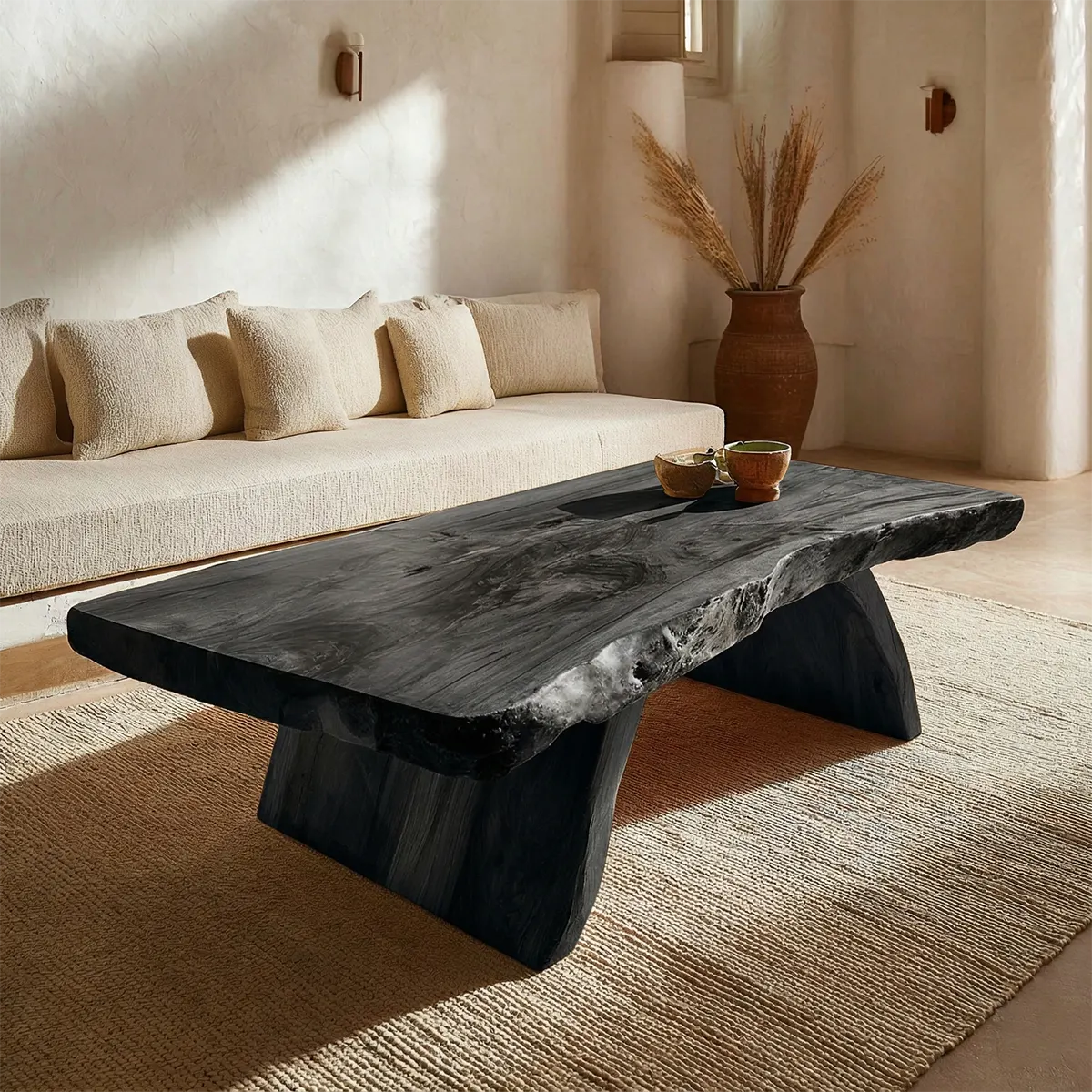
- Tabletop: A thick slab with the tree's outline kept on both long sides, and kept aggressively — the profile steps in and out at sharp angles instead of waving gently.
- The margin: Dark, crusted and broken, running the full length of each long side, with open pockets, bark shadows and small cavities left where the timber ended and the bark began.
- Treatment of the margin: Cleaned of anything loose, consolidated where it was fragile and sealed. It stays craggy to look at and firm to the touch, and it is not levelled off into a curve.
- Contrast: Because the field is so pale, the black margin reads as a drawn line around the whole board — the single loudest thing about the piece.
- Base: Two solid wood supports, each cut as a shaped panel rather than a plain block — narrower where it meets the underside, widening as it descends.
- Silhouette of the supports: The outer profile of each panel is waisted and curved, sweeping outward at the bottom into a broad rounded foot, so the pair stands like a splayed trestle.
- Edges of the supports: Their vertical edges follow a natural contour of their own, undulating slightly rather than running dead straight.
- Set-in position: Both supports stand well inboard of the ends, and the slab reaches out past each of them.
- Surface: A low satin, close to matte, which suits a pale board and keeps the crusted margin looking like timber rather than lacquer.
- Structure: A slab and two shaped supports. Nothing opens, nothing closes and nothing is stored.
- Available in three sizes: 39"W × 20"D × 16"H, 47"W × 22"D × 16"H, and 55"W × 22"D × 16"H.
A Statement of Nature
Put your hand flat on the middle of this board and it is cool, level and completely smooth. Slide it outward towards either long side and everything changes: the surface breaks, drops into a pocket, rises over a hard black ridge and stops. Two entirely different materials, and the same piece of wood.
That contrast is why the board was chosen pale. On a dark slab the crusted margin would vanish into the background; against this cream and olive ground it is drawn in ink, following every step and re-entrant of the outline from one end to the other.
The setting it wants is plain and warm — lime-washed walls, a low built-in seat, clay urns, matting underfoot. This is Rustic and Wabi-Sabi territory rather than anything polished, and the base agrees with that: it is shaped by hand and it shows, which is exactly the register in which a table like this ought to be made.
Natural Materials & Craftsmanship
Slab and supports are all Natural Solid Wood, worked in real section. The tell is on the end of the board — the pooled figure crossing the face runs straight down through the depth and out onto the underside, and the supports show grain running vertically through their whole height.
Selection is nearly the whole job on a board like this. The value is in a broad pale field with enough movement to hold attention and an intact margin on both sides, and boards that offer both are rare. Nothing here is bleached towards a uniform cream, and nothing is filled to level out the pockets.
The two halves of the work go in opposite directions. The faces are flattened, stabilised and brought up to a smooth even satin. The margins are cleaned back only as far as soundness requires — loose crust away, weak fibre consolidated, cavities sealed and left open — so what remains is the actual boundary of the tree, safe to touch and untidy by design.
The supports are the sculpted part. Each panel is cut to its waisted profile, its foot swept outward, its vertical edges shaped to follow their own contour, then the faces are worked by hand and the whole panel seated into the underside on a hidden housing. Surface tone is offered as Brown Tone Finish, Walnut Tone Finish, Oak Tone Finish and Black Tone Finish, each of which is a colour of finish applied over the same Natural Solid Wood.
Sculptural Design
The slab is thick, and it is meant to be seen as thick. Nothing is chamfered underneath to cheat the depth, so from a low seat you read the full section of the board and the black margin running along it at eye level.
The outline is unusually forceful for a coffee table. Where most natural edges roll, this one steps — the board widens abruptly, holds, then cuts back in, and it does so several times on each long side, so no two feet of the perimeter look alike. The two short ends are cut across cleanly, which stops the whole thing becoming shapeless.
The supports are the second surprise. They are not plain rectangles: each is a panel whose sides curve, drawing in below the slab and flaring outward again as it approaches the floor, where it lands on a broad rounded foot. Set as a pair, they lean away from one another and read as a trestle rather than as two posts, and that outward stance is what settles a heavy slab so firmly.
Standing them inboard leaves both ends of the board projecting into open air, which keeps the corners free for seating and lets the eye finish on the natural outline. Between and behind the supports nothing has been added at all — no rail, no lower level, no case, no compartment, and no visible metal anywhere on the finished table.
Versatile Placement
Built as the central low table for a seating group, and best where light comes in low across the room — that is when the crusted margin casts its own shadow and the board looks the way it should.
- Living room, in front of a long low seat or a built-in bench, with matting or a flat-weave beneath it.
- Plaster-walled or lime-washed interior, where a pale board keeps the whole scheme in one tonal family.
- Sunroom or courtyard-facing space, where raking afternoon light picks out every pocket along the sides.
- Lounge or retreat space, as the one piece of genuine roughness in a very calm room.
- Reception or wellness area, where guests come close enough to see how much of the tree was kept.
Customization
Three sizes are produced, all at 16"H: 39"W × 20"D × 16"H, 47"W × 22"D × 16"H, and 55"W × 22"D × 16"H. The two larger widths also take an extra two inches of depth, and on this design that depth matters more than usual — the outline steps in and out so sharply that a narrow board loses width fast at every re-entrant. Custom sizing may be available on request; give us the length of your seating and the clear floor around it and we will advise.
Four tone finishes are available: Brown Tone Finish, Walnut Tone Finish, Oak Tone Finish and Black Tone Finish. Every one describes the colour of the finish applied over the same Natural Solid Wood, in all three sizes, and none refers to a timber species. Tone matters enormously here because the whole effect rests on contrast — the lighter tones hold the field pale and leave the dark margin standing out hard against it, while the deepest tone brings field and margin close together and mutes the drawn-line quality entirely.
Natural grain and tonal variation make every piece one of a kind, and on this design the outline itself varies as much as the figure. The number of steps in each long side, the run of the pockets and the amount of crust that survives are determined by the board on the bench and will not repeat the photographs. Minor dimensional variation may occur due to the handcrafted process, which is unavoidable when the perimeter is set by the timber. Production photos or a short video of your own board may be provided on request before we crate it.
Care & Maintenance
The open field wipes down with a soft dry cloth in seconds. The margins do not — use a dry soft-bristle brush along both long sides, working into the pockets and along the underside of the crust, because a cloth catches on the ridges and leaves fibres behind in them.
Coasters under drinks and a mat under anything hot, always. Deal with spills at once and dry the area properly, and be quicker still if anything runs towards a side, since liquid reaching an open pocket travels further into the timber than it does across a sealed face.
Keep the table away from heating outlets and out of hours of direct sun. Sustained sun on a pale board is the one thing that will visibly change it — the field will warm and darken while the margin stays as it is, which shifts the contrast the design depends on. Slight seasonal movement across the width of the slab is normal in solid wood.
Set the piece on level flooring and confirm both feet bear evenly before loading the top; on matting, check that neither foot is riding on a ridge in the weave. Refresh the surfaces once or twice a year with a suitable wood oil or wax, using a light hand on the crusted margin so nothing collects in the cavities. Move it with two people lifting from directly beneath the supports — never by an overhanging end, and never by hooking fingers into the natural edge.
Important
- Natural edge retained on both long sides, with crust, open pockets and cavities cleaned, consolidated and sealed rather than sanded away.
- Sharply stepped outline taken from the board itself, so the perimeter of every table is different.
- Two shaped solid wood supports, waisted in profile and flaring outward to a broad rounded foot, standing as a splayed trestle.
- The vertical edges of the supports follow their own natural contour and are not cut straight.
- Supports set inboard, so both ends of the slab project unsupported.
- Nothing beneath the top — no rail, no lower level, no drawer and no enclosed space.
- Handcrafted from Natural Solid Wood.
- Decorative items are not included.
Once our products are finished, we disassemble them into several pieces before shipping. This isn't a shortcut — it's actually to protect your order! Our pieces can be large and bulky, so breaking them down makes them much easier to package securely and move safely, which means your item arrives without any dents, cracks, or damage from bumps during transit.
No worries about assembly, though — our craftsmen carefully design every joint and connection to fit together snugly and precisely once you put it together. Plus, we include detailed assembly instructions with every order, so you can set everything up with confidence.
Note
- Listing includes the coffee table only, in the size and finish selected.
- Decorative items visible in the photographs — the rough speckled stone bowl, the green-glazed footed bowl, the small turned wooden bowl, the two terracotta urns, the dried grasses in them, the upholstered platform seat with its cushions, the woven floor covering and the wall lights — are not included.
- Each piece is handcrafted from Natural Solid Wood with unique grain and tonal variation.
- The crusted margin along both long sides is an intentional feature of this design. It is sealed and stable, but it is deliberately left rough and stepped rather than dressed smooth.
- Open pockets, dark inclusions, knots and small consolidated checks are natural to a board of this kind and are not treated as faults.
- The supports are shaped by hand, so the curve of the waist and the spread of each foot differ a little between tables.
- Tone finish names indicate the colour of the applied finish only, and the slab and supports are cut from the same Natural Solid Wood across all three sizes.
Shipping
Free Shipping Within the US
We proudly offer free shipping on all orders delivered within the United States.
Estimated Delivery Time
Each piece is carefully handcrafted to order. Total delivery time is approximately 10-17 business days, including production and shipping.
Returns
30-Day Return Policy
If you are not completely satisfied with your purchase or simply change your mind, you may request a return within 30 days of receiving your order. We cover the full cost of return shipping for all returns — no return shipping fee or restocking fee under any circumstance.
For full details, see our Shipping Policy and Refund Policy.
Wood Care Instructions
Avoid Water & Excess Humidity
Wipe away any standing water immediately and avoid prolonged exposure to moisture. To preserve the beauty and durability of the Natural Solid Wood, do not place the product in excessively humid areas or near direct heat sources.
Protect From Direct Sunlight
Extended exposure to strong sunlight may cause the wood to fade, dry, or naturally shift in color over time. For best longevity, place the product in a cool, dry environment with soft or indirect light.
Gentle Cleaning
Dust regularly using a soft, dry cloth. Avoid harsh cleaners, chemicals, or abrasive materials that may damage or scratch the wood surface.
Periodic Wood Maintenance
Every 6–12 months, apply a wood conditioner or natural wax to help nourish the wood, maintain its luster, and improve moisture resistance.
Protect the Surface
Use coasters, pads, or protective mats under glasses, vases, and heavy or sharp objects to help prevent scratches, dents, or surface marks.
Inspect & Tighten Hardware
For products featuring screws, joints, or traditional mortise-and-tenon construction, periodically check and tighten connections to ensure long-term stability and strength.


Handcrafted from Natural Solid Wood
Handcrafted from Natural Solid Wood
Handcrafted from Natural Solid Wood
Handcrafted from Natural Solid Wood
Handcrafted from Natural Solid Wood
Handcrafted from Natural Solid Wood
Handcrafted from Natural Solid Wood
Handcrafted from Natural Solid Wood
Handcrafted from Natural Solid Wood
Handcrafted from Natural Solid Wood
Handcrafted from Natural Solid Wood
Handcrafted from Natural Solid Wood
Handcrafted from Natural Solid Wood
Handcrafted from Natural Solid Wood
Handcrafted from Natural Solid Wood
Handcrafted from Natural Solid Wood
Free Shipping Across USA
Free Shipping Across USA
Free Shipping Across USA
Free Shipping Across USA
Free Shipping Across USA
Free Shipping Across USA
Free Shipping Across USA
Free Shipping Across USA
Free Shipping Across USA
Free Shipping Across USA
Free Shipping Across USA
Free Shipping Across USA
Free Shipping Across USA
Free Shipping Across USA
Free Shipping Across USA
Free Shipping Across USA
Why Choose Us

Natural Solid Wood
Rich grain and one of a kind character.
Made to Order
Prepared with care for each design.
Free Shipping
Delivered across the USA with care.
30 Day Return
Added confidence after purchase.
Secure Checkout
Protected payment experience.
Custom Sizes
Selected designs can fit your space.

Natural Solid Wood
Rich grain and one of a kind character.
Made to Order
Prepared with care for each design.
Free Shipping
Delivered across the USA with care.
30 Day Return
Added confidence after purchase.
Secure Checkout
Protected payment experience.
Custom Sizes
Selected designs can fit your space.
Frequently Asked Questions
Are the colors exactly the same as shown in the photos?
Are the colors exactly the same as shown in the photos?
We strive to present every finish as accurately as possible. However, because each piece is handcrafted from Natural Solid Wood, natural grain variations, lighting conditions, and screen settings may cause slight differences in appearance. These subtle variations are part of what makes every piece unique.
Does the furniture require assembly?
Does the furniture require assembly?
Some products may require light assembly upon arrival. All necessary hardware and installation instructions are included to ensure an easy setup experience. If you need any assistance, our support team is always available to help.
Is the wood protected against termites and moisture?
Is the wood protected against termites and moisture?
Yes. Each piece is carefully prepared and finished for long-lasting durability.
- The wood is properly dried and treated before production
- A protective finish is applied to help resist moisture and daily wear
- Secure packaging helps protect the furniture during transit
With proper indoor use and care, your furniture is designed to remain beautiful for years to come.
Do you offer customization?
Do you offer customization?
Yes, we gladly offer customization options for selected products. You may request adjustments to dimensions, finishes, or certain design details to better suit your space and preferences. Please contact us to discuss your custom request.
How should I care for my furniture?
How should I care for my furniture?
To keep your furniture looking its best:
- Wipe regularly with a soft dry cloth
- Avoid harsh chemicals and abrasive cleaners
- Keep away from prolonged moisture and direct heat exposure
- Use wood-safe cleaning products when necessary
Proper care will help preserve the natural beauty of the wood over time.
Do you ship internationally?
Do you ship internationally?
No, we currently do not offer international shipping. At this time, we only ship within the United States, and free shipping is included on all orders.


